
જેના મિત્રો સરસ, એની જીન્દગી સફળ!

The one who has the company of True Friends, lives a truly successful life.

Friendship is the most important and influential factor of our lives. Friends provide the stimulus to the way we think, speak, act, talk, behave, etc. They delineate our character and mould our success stories. Shivam House was very much privileged to celebrate the value of “Friends” as part of weekly assemblies.
So, how do we make friends? What kind of success can a friend help us achieve? Generally, we make friends based on the following:1. Usefulness: How useful can one be to you? Will he lend me his perfume? Will he share his chocolates with me? Will he help me to complete my homework? Will he support me in case an adverse situation arises? These are some of the questions we ask ourselves and confirm, before making friends.

2. Pleasure: Some people are fun loving and their presence drives all your worries away. They always have some funny things to share that make you roar with laughter. Some others may accompany you in shopping and watching a movie. You may share the same interests in academics sports and technologies, for example:

  • I like watching and discussing about American Football and Raj also likes it, so he is my best friend.
  • I like gadgets and latest technology like an Apple iPhone and Ani shares with me the latest apps and games of iPhone, so he is my best friend.
  • I enjoy making working models and Jeet is also interested in making scientific models, so he is my best friend.

3. Virtue: When someone has creditable personality traits or values in him, we are naturally attracted to that individual and want to make him our friend. Some of these virtues include being respectful, faithful, effective communication, proactive, supportive nature, understanding nature, etc. The fact that he is your friend makes you feel proud. You will be ready to do whatever such a person tells you to do.

So now there is another very important question as to which of the above mentioned friends are good friends? And yes, there is still the question of definition of success.

Thinking carefully, the type 3 ‘Virtuous Friends’ are the ideal friends. But it is also true that one who is virtuous may not be as helpful and joyful. So then, type 1 ‘Useful Friends’ may be a good option. But there may or may not be situations in life where you may need help from people and hence, such friendship lacks quality and constant contact. Now the only option that remains is type 2 ‘Pleasure loving Friends’. But how long can one keep on laughing at jokes and foolishness of some other people. Moreover how long will you share things of interest? There will be a point of saturation reached, someday.

In a way, all of the above discussed friends are good friends. We need friends with virtues so that we can become virtuous, we need friends who are useful as they will be ready to share things with us, and we definitely need friends who bring joy and pleasure to our life and who share the same interest as ours. As Param Pujya Swamiji has regularly emphasised that whatever good we find in others we should observe, meditate and imbibe. Moreover, when we get to learn something good from someone he is our good friend.

Furthermore, Swamiji has also explained through His discourses that a true friend is the one who…

  1. Will help you to achieve academic success and will help you to make your senses positive.
    One may claim that he has friend(s) who helps him academically and they both are academically successful. But the real question to ask is:
    Are they helping each other to see positively? Are they helping each other to talk positive about others? Are they helping each other to listen positive about others? Are they selflessly helping others by sharing knowledge?
    Thus, a true friend will help you make your senses positive, develop the focus and hence become academically strong.
  2. Will help you to settle down in life, live a morally and culturally sound life, maintain positivity and live happily.
    One may say that he has earned a lot of money in life and he is successful. He may also claim that he has lots of friends who are extremely rich. But the question arises, is earning money the true success of life? Money will get you all the necessary materialistic comforts, however it will not be able to buy respect and humility; it will not fetch you a tension free live and it will not fetch you good and positive thoughts. Only a true friend will teach one to live a morally and culturally sound life and that will help one to develop humility and gain respect.
    A true friend will help you to stick to positive thoughts and hence, will be loyal and committed at all times.
  3. Will teach you to grow spiritually i.e. to live with ‘Atmiyata’ and ‘Suhradbhav’. He will support you in following the commands of Guru and will teach you to offer service with devotion. He will teach you to celebrate the diversity and adversity of life. He will teach you how to attain the true bliss of God.

Under the guidance of teachers, the Shivam House team made a humble effort to put forth the above discussion in the daily assemblies through videos, presentations and speeches.

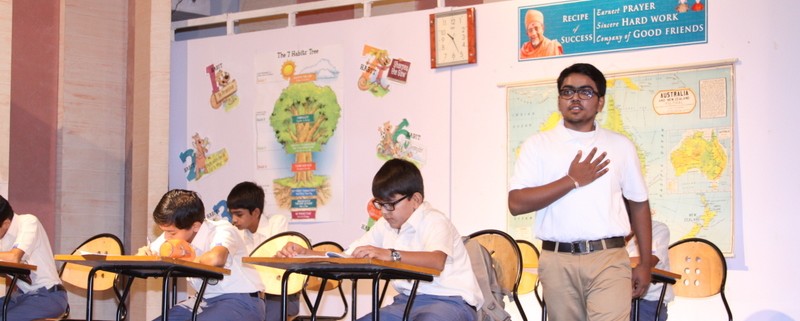
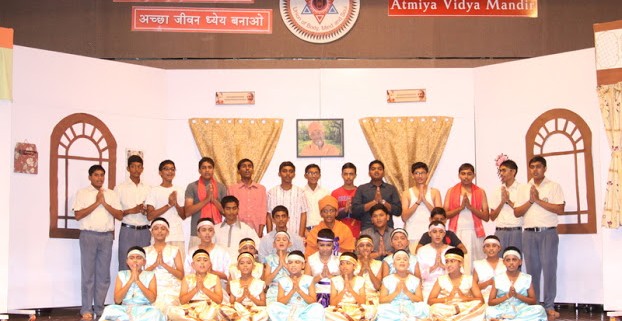
The week concluded on 9th August with a heart touching drama depicting the importance of true friends. In the drama, it was portrayed that true friendship is brimming with faith, acceptance and selfless sacrifice. It not only benefits the friends but influences the people around in a positive manner.
Written by: Prabhudarshan Sir

Glimpses from Swamishree’s Ideal Student Life

Behind the iconic name of the school ‘Atmiya’ lies a noble mission of His Divine Holiness Param Pujya Hariprasad Swamiji. It is to nurture the qualities of compassion, harmony and devoutness in the students of Atmiya Vidya Mandir. Swamishree is an epitome of these values and His student life is a perfect example of an ideal student life, hence in the third week of July, from 14th July to 20th July 2014, Sundaram House members presented glimpses of Swamishree’s inspiring student-life.


In this week, Sundaram House members discussed how Swamiji’s student life is like a road-map showing a clear-cut route to success and happiness. On Monday, Purvesh Sir explained that if we analyse Swamiji’s student life, we can find glimpses of the qualities of sincerity, hard work, devotion and compassion. On Tuesday, students were shown through a video presentation, how Prabhudasbhai (Swamishree’s childhood name) was obedient and respectful towards his parents. Wednesday brought forth a presentation on Swamishree’s school life in which students learnt how Prabhudasbhai excelled in his academics through constant hard work, full attention and being meticulous about his books. On the following day, students were privileged to relive, through a video, one of Swamishree’s visits to AVM. In this video, by giving example of His own life, Swamishree advised students to stay away from misleading movies and remain focused to the studies. On Friday, Mukesh Sir, elucidated how qualities of respectfulness, acceptance and positive attitude made Prabhudasbhai an ideal student.And then arrived the most awaited, most significant, eventful day of creative assembly where an incident of Prabhudasbhai’s life was enacted. A drama presentation explained the students about Swamiji’s unflinching focus on maintaining his positive attitude and harmony with others in spite of all unfavourable circumstances. This creative assembly was a source of insight for the students as they realised not to expend their energy in those matters which do not contribute in living an ideal life. The dramatization of ‘Dudhpak’ incident from Swamiji’s life brought the students to a deeper understanding of their purpose of life. Thus, with a better understanding of their goal, they can stay focused in fruitful work.

In a world which is full of alluring interferences for the students, they have a daily battle with the distractions to stay prolific and in such a scenario, analysis of Swamishree’s student life helps to create a firewall against all distractions. As a matter of fact, by this week’s presentations, students are highly inspired to maintain acceptance, forgiveness and harmony amongst themselves which further creates clarity of destination.

Guru: God Personified

Every nook and corner of AVM campus and every life associated with it, has been flourishing through the ever flowing grace of His Divine Holiness Param Pujya Hariprasad Swamiji. Hence, at AVM, Guru Purnima is just not a commemoration of Swamishree’s glory but a day to reunite with His supremacy by offering our prayers to Him.“Swamishree always blesses us with all success and happiness, we just need to be committed and resolute for a good cause and a good goal.” said Suhrad Swamiji while addressing the congregation of Guru Purnima celebration in the Atmiya Prayer Hall on campus. In the presence of all elders, teachers, hostel staff, students and all members of Atmiya family, the programme started with Thakorji’s pujan by saints from Haridham and principal Vijay Sir. The junior class’ students sang melodious bhajans admiring the beauty of a Guru-guided life.


Thereafter, the host of the programme, Mukesh sir narrated a few stories to the students elucidating that the Guru is God manifested and He cultivates the human potentials. The students were reminded that it was the day for them to resolve to those easy-to-follow yet hard-to-stick to injunctions given by Swamishree to all AVM students and to realise that following these will help them to be a better human being.The inspiring and elevating words of Pujya Suhrad Swamiji on this pious occasion explained that the best way of celebrating Guru Purnima and offering true reverence to Swamishree is by self – reflection to be worthy of His blessings. He further added that it is a day to decide to resort to prayers and take divine help each time we deviate from our goal. This would certainly bring a realisation which leads to improvement.

So let’s decide, how we are going to deal with the darkness within us – with the glare of fascinating distractions that obscures OR with the light – the glow of Guru’s grace that illuminates!!!

3Ds for an Ideal Student: Determination, Dedication & Devotion

The destiny of a nation depends on the character of people. And as defined, the character is not merely the awareness of some values but also both, the desire and capacity to uphold them in practice. On one hand, we are experiencing a rapid global change, and on the other, we all are also hoping for peaceful and prosperous global community.

Our school functions on the essence of the basic Indian culture, supported by His Divine Holiness Hariprasad Swamiji. According to him, every child can be an ideal child, if he is determined, devoted and dedicated to understand the core of every task assigned to him. It is said that an ideal student is the wealth and future of the nation. Such student is a hope of a family and pride of the school. Such bright and good students are the gems of an institution, thus they are able to become responsible citizens, statesmen and leaders of tomorrow.

Working on the same line, Satyam House took an initiative to project the aspect of “3Ds” for an ideal student i.e. ‘Determination, Dedication and Devotion’. It was demonstrated in regular assembly through real life examples and live role models. Everyday a personality was selected and was appreciated by teacher and students together.

Day
An Ideal student
Monday
Dr. Prakash Aamte, the sincere social worker
Tuesday
Sardar Patel, an iron man of India
Wednesday
APJ Abdul Kalam, the former President of India
Thursday
HDH Hariprasad Swamiji, the spiritual master
Friday
Helen Keller, the first deaf & blind person to earn a bachelor
degree
Saturday
Sage Panini, a great Sanskrit Master
All the presentations depicted the value in its real sense. It not only helped students discover the hidden powers of 3Ds – Dedication, Determination and Devotion, but also help them in setting good examples for their personal and professional lives.
– By Satyam House Team

Habits – Key to Effectiveness

We are what we repeatedly do.
Excellence then, is not just an act, it is a habit.
-Aristotle

The power of habits is mind-boggling. If we develop positive habits then we can multitask efficiently and achieve the desired results in all that we do. The question is, “Is there any standard technique, strategy or rules that can help us to develop the habit of becoming successful?” The answer to this is very well explained in the very inspiring book, ‘The 7 Habits of Highly Effective Teens’ by Sean Covey. In this book, he has put forward the seven fundamental habits that can help a teenager achieve the desired goals, fulfill his dreams, build a successful career, live a happy and stress free life and build a highly esteemed character.

Shivam House had an opportunity to explore, analyze, correlate and share the 7 habits of highly effective teenagers with all the students at AVM throughout the week. The following points were discussed in the assembly:

Habit 1: Be Proactive
· I am a responsible person
· I take Initiative
· I choose my actions, attitudes and moods
· I do not blame others for my wrong actions
· I do the right thing without being asked, even when no one is looking

Habit 2: Begin with End in Mind
· I plan ahead and set goals
· I do things that have meaning and make a difference
· I am an important part of my classroom and contribute to my schools mission and vision, and look for ways to be a good citizen

Habit 3: Put First Things First
· I spend my time on the things that are most important. This means I say no to the things I know I should not do
· I set priorities, make a schedule and follow my plan
· I am disciplined and organized

Habit 4: Think Win-Win
· I balance courage for getting what I want with consideration for what others want
· I make deposits in other’s emotional bank accounts
· When conflicts arise, I look for third alternatives

Habit 5: Seek First to Understand and then to be understood
· I listen to other people’s ideas and feelings. I try to see things from their view points
· I listen to others without interrupting
· I am confident in voicing my ideas
· I look people in the eyes when talking

Habit 6: Synergize
· I value other people strengths and learn from them
· I get along well with others, even people who are different than me
· I work well in groups
· I seek out other people’s ideas to solve problems because I know that by teaming with others we can create better solutions than any one of us alone
· I am humble.

Habit 7: Sharpen the Saw (Perpetual Learner)
· I take care of my body, by eating right, exercising and taking rest.
· I spend time with family and friends.
· I learn in a lot of ways and lots of places, not just at school.
· I take time to find meaningful ways to help others.


Under the guidance of teachers, the students explored what the parents, teachers and the business world expect from all the students. It was also an opportunity for the students at AVM to realize how the principles of AVM as laid down by Param Pujya Hariprasad Swamiji are leading them towards becoming the leaders of tomorrow.

What
Parents, Businesses and Teachers want for students?
Mapping
Habits
Swamiji’s
Vision
Independence
Initiative, Self Motivation
Habit 1-3
Be proactive
Begin with end in mind
Put First Things first
Students should have a goal in life which should be serving parents
and society…
Self Confidence
Planning Skills
Goal Setting Skills
Organization/Time Management
Interdependence
Conflict Management Skills
Habits 4-6
Think Win-Win
Seek first to understand then to be understood
Synergize
The Student should have stable Speech (vani), righteousness of act
(vartan) and Thinking (Vichar).
Communication Skills (both listening and presentation skills)
Honesty
Fairness
Openness to Suggestion
Team Work
Problem Solving
Decision Making
Creativity
Renewal
Technical Skills
Habit 7
Sharpen the Saw
  • Physical
  • Mental
  • Emotional
  • Spiritual
The student should be a leader; wherever he should go he should make
changes.
Love, passion, dedication, devotion, determination, enthusiasm and
spirituality.
Good Health and Hygiene
Emotional Stability
Analytical Skills
Involvement in Meaningful skills


 Students understood that if they started with any one of the above mentioned habits, then slowly and steadily they will be able to imbibe the others. This will not only help them to become successful but also a good human being.

Such a person will be a significantly contributing factor to the family, society and nation.

Compiled by: Shivam House Team

Being blessed by Him to be better

It was the eventful month of February and the so called examination mammoth was inching closer……the students and the teachers were feeling nipped; Occasionally, the pursuit of targets left the minds weary and the fatigue engulfed these mortal forms,… as if passivity was hovering over for its prey: consequently, a growing urge for a divine help was apparent from the swelling visitors to the altar at school’s prayer hall….hurrah !!!! The prayers were answered!!! His Divine Holiness Param Pujya Hariprasad Swamiji Maharaj arrived at AVM, His very glimpse was like a sight of an oasis by the parched travellers, there were delighted faces and elated hearts, the joy was unfathomable as the students, the teachers and the entire AVM family and everything around here.. took on a bright sheen as if rejuvenated and imbued with happiness by His presence.

His boundless love for the students called for an assembly (Sabha) which was held in the school prayer hall on 25th February 2014. The hall was brimmed with devoted heads and eager hearts as Swamishree addressed all with His kind and deep concern. To begin with, the students sang a heart stirring lyrical hymn… adding a bit edge to the ardent ambiance and there came a benign smile on Swamishree’s face as He listened to these prayers being offered to Him. Purvesh Sir handled the mic and being a zestful host of the programme, he shared a few incidences where students of AVM evidently practised ideal behaviour in classes, playground and in hostel. Soon after Vinamrabhai of Std 8th was invited on the stage to present a brief report on cultural activities through which lessons of harmony and the moral values are imparted to the students. Thereafter, Purvesh Sir specified a few more incidents stating how the very mission of the school “Union of Body, Mind and Soul” is being accomplished. This brought an appreciating and enchanting gesture on Swamishree’s face and His encompassing gaze left us in total bliss. After that Abhishekbhai Ariwala and Nileshbhai Yadav of Std 12th offered a prayer on behalf of all students and asked for His blessings in all their endeavours. It was followed by a much awaited and momentous opportunity for the students of class 12th to get one-to–one meeting with Swamishree. He was being affectionate, listening patiently to each one of them enveloping them in His divine aura and blessing them.

Then came the ever auspicious “better one day in your court than thousand elsewhere” moment, when Swamishree voiced His golden words. How convincingly yet persuasively He explained to the students that they should always be extremely respectful to their parents and withdraw instantly the very thought of aggressiveness towards elders in the family! Students listened very earnestly when Swamishree stressed over becoming God-Loving and adopting the habit of resorting to prayers in all times. Moreover, He strengthened their commitment and zeal for being better by insisting them to avoid watching distracting movies and keeping good company. Thus, Swamishree blessed students not only for a brilliant career but induced the contemplation to lead a fearless existence with righteousness, purity of intentions, positive thinking and focused mind.

If glorious sun shines above our head … what more light needed to be asked for? Seemingly Swamishree’s very presence among us exudes a powerful scent of serenity, how fortunate we are to be sheltered under His umbrella of love and enjoying the bliss!!!!!!!

SARANSH 2013-14

The myriad celebrations throughout the year 2013-14 culminated into a grand, touching and inspiring closing ceremony on the 15th of February 2014, titled “Saransh – Lets celebrate each other”.This year was a very memorable and a historic year for Atmiya Vidya Mandir in so many ways. Historic because the year 2013-14 marked the 10th anniversary of the school’s inception. It was memorable and enjoyable as we had as many as 8 creative assemblies, 8 academic competitions, 6 inter-house sports competitions, 3 soft board displays and many other cultural activities full of singing and dancing. The annual athletic meet this time had many record breaking performances by the students on the track and field events.

The ceremony presented the moment to give away the awards to all the winners. But before we declare that, we would like to make the readers aware of what Saransh is. Saransh is about re-living those incredible moments that the school has given us students this year. Saransh is not merely an event of giving away awards and trophies, but, is a highlight of what we all could achieve together as a school. And it is also about appreciating each other and counting our blessings. This legacy event celebrates the very core of our school: Atmiyata.


The function began according to the school’s tradition, with Thakorji’s poojan. It was followed by the marching off of all the student council members.Next was a unique performance that was never witnessed before in our school. This performance needed a lot of hard work and practice to perform live in front of the whole school. It was named ‘Naad Brahma’. Students as young as 7 years to 15 years old took part in this mesmerizing performance. It included some budding musicians from the school playing various instruments as well as young singers lending their voice to some unbelievable musical melodies. This miracle was possible because of the vision and hard work of our music teachers Jaimin Sir and Himanshu Sir. Thank you Jaimin Sir and Himanshu Sir.

Closing ceremony also presents an opportunity to various house representatives to express their gratitude and share their experiences. This year, the house captains (all from class 10) gave speeches instead of the house conveners. It was heartening to see the leaders of tomorrow speak confidently in front of a sizable audience. They expressed their experiences about how they felt leading their house. They also thanked the students who contributed significantly towards their houses.

The members of the school student council, especially the captains, vice captains, sports captain, vice head boy and head boy had been instrumental in carrying out various activities throughout the year. To applaud their efforts they were all given certificates by respected principal sir.

Then it was the time to give away trophies and awards for different activities held in the school.

The winners were:

  • Best Sports House Satyam House
  • Best Academic HouseShivam House
  • Best Soft Board DisplaySuhradam House
  • Winners of the Debating Club CompetitionShivam House
  • Best House in Creative AssembliesShivam House
  • The Annual Athletic Meet ChampionSundaram House


The other set of awards were received by the following inspiring performances/talented individuals:

Next, respected Vijay Sir and respected Haresh Sir were called up on the stage as it was the turn of the biggest announcement of the evening. As they announced the runner up winners: Shivam House, and the BIG WINNERS of the year – Sundaram House, the entire hall was filled with voices of joy of the students and teachers alike. Sundaram House representatives came forward to receive the glittering trophy of the year.

Throughout the year, many people from different segments of the school contributed immensely to make the year successful and enjoyable for the students. So it was only fair that on behalf of the students someone would deliver a vote of thanks. Being the head boy of the school as well as the role model for all the students, this responsibility was bestowed upon Sachinbhai Verlekar. During his speech, Sachinbhai thanked the school management, principal sir, all academic teachers, sports teachers, house masters, didis hospitality staff and security team for their love and affection throughout the year. He showed maturity beyond years as he completed a very touching speech.

The ceremony then ended with aarti of Thakorji. The academic year 2013-14 may have come to a near end but the memories of this historic year will remain in the memories of the students and teachers for many years to come.

Written by: VINAMRA AND SMIT (GRADE 8)

INDIA – THE LAND OF FESTIVALS

“Festivals of India”, one of the most awaited themes, knocked the doors of Satyam House on 3rd March 2014, to which, Satyam House responded quite earnestly and enthusiastically. Throughout the week the team brought to the students’ attention various interesting and significant aspects of different festivals of different regions across the country.

The week started off with a thoughtful talk delivered on ‘The Importance of Festivals’ supported by colourful visuals and also coupled with what does festival mean to Param Pujya Hariprasad Swamiji. Subsequently, through the following days, the students were shown how Swamiji celebrates different religious festivals at Haridham followed by the various festivals from south (Pongal, Onam, etc.) to those celebrated in the western and eastern parts of the country. The students learnt about the rich tradition and culture of India with absolute clarity of the pious purpose of celebration through those festivals.

The week ended with special festivals celebrated to preserve our environment like Van Mahotsav. During the week, everyone witnessed a unique collection of videos accompanied by graceful talks delivered by students of Satyam House.

Continuing with the tradition, in the junior assemblies, the value was celebrated by presenting the actual rituals, worships, dances and songs. The week was celebrated with great pomp and enthusiasm. Each day the assembly was so lively! And to this was added the significance of upcoming ‘Atmiya Yuva Mahotsav’, the festival of all festivals. Students were given a different vision by explaining how ‘Atmiya Yuva Mahotsav’ serves the purpose of Holi, Diwali and Uttarayan and how Swamiji has envisioned the future of Indian youths. But all this wouldn’t have been possible without the creative minds and hard work of the teachers. They were the reason for the successful accomplishment of the week.

In a nutshell, the main aim of Satyam House team was to leave a message in the hearts of everyone that we should celebrate each moment of our life like a festival, whether it is favourable or unfavourable. Life will be a heaven if we celebrate each moment of our life like a festival.

So let us live the remaining of our lives like a festival!

Written by Sumit Choudhary

Responsibility & Accountability

“One cannot be casual today thinking that tomorrow will be bright!”

Responsibility is one of the most important aspects of human existence and personality. It is taking accountability for all our thoughts, feelings and actions. It is a characteristic that can make an individual successful in life.

Shivam House celebrated the basic, yet a very important value of life ‘Responsibility and Accountability’ in the first week of February. Throughout the week Shivam House made a humble effort to share with the students the real meaning of responsibility and accountability and how they are a valuable tool in achieving goals in student life and beyond.

Some of the aspects of Responsibility and Accountability shared with the students are as follows: When one becomes aware of his duty and knows what is expected of him, he becomes responsible for that duty.

1. When we were small we were taught by our parents to brush our teeth after waking up, then have bath and perform other daily chores in an appropriate sequence. Our parents made sure that over the years we did it sincerely and we understood the importance of performing our daily morning chores. Once we know that we have to do all this and in a particular sequence as taught, then it becomes our responsibility to follow our parent’s instructions.

2. At hostel, didis and house masters make students aware of folding their blankets, hanging the towel properly in the balcony, folding clothes, arranging cupboard, etc. then it becomes the responsibility of the student to follow his guardian’s instructions.

3. At school when students are taught various topics in class and given homework or asked to do the revision of the topic then it becomes their responsibility to follow their teacher’s instruction.

4. Different places around the world have their own customs, rules and regulations that they follow. When one goes to these places one must follow the rules and regulations that they follow. It becomes their responsibility to follow the native customs, traditions, rules and regulations.

Students were explained that as responsible members of Atmiya family it is their foremost responsibility to follow the basic principle of Atmiya Vidya Mandir i.e. ‘Atmiyata’ and be aware of the School Discipline policy.

Thus responsibility means doing what we are supposed to do and following rules and regulations.

Further, when one becomes responsible for any task, he starts keeping an account of it, meaning: he keeps an account of how many times he was successful in performing his duties and following rules, and how many times he failed and why? What can he do to overcome his failures? When one is able to account for all these questions based on the task assigned to him in a just manner without saying a lie and being honest is called accountability.

Responsibility and Accountability go hand in hand. The more one becomes responsible towards a task, the more one becomes accountable for it and the more one becomes accountable for the task the more one becomes responsible for it.

Moreover, it is believed that, the habits which are developed at the early age lasts longer. The most common problem which can make students irresponsible, is making excuses. Irresponsible people tend to shift the blame onto influential factors, and vocalize them as excuses. Students acknowledged that another way to accept responsibility is to stop putting the blame on everyone around. Blaming other people instead of one’s own self will not only make one spiteful, but it will make one powerless to change his life for the better.

Students were also informed about the different types of responsibility like personal, social, moral and family responsibilities. The points covered in the assembly were as follows:

1. Responsibility and Accountability means:

  • a. Following rules and taking care of your duties
  • b. Answering for their own actions, not giving excuses and not blaming others
  • c. Being trustworthy

2. Why become responsible and accountable?

  • a. They are core values for living honourably
  • b. They increase self-esteem and confidence
  • c. They increase trust between people
  • d. Makes us adorable

3. Responsible children should

  • a. Understand and accept consequences of their actions and try to correct their mistakes
  • b. Complete assignments and tasks
  • c. Clean up surroundings
  • d. Do the right things and apologize if wrong
  • e. Follow through without giving up
  • f. Understand the effect of their actions on others

Students got information about what is responsibility, why is being responsible important, what is expected from a responsible student, how to put responsibility into action in their day to day life through different quotes, presentations, stories, advertisements, real life incidents of great personalities, videos, etc.

The truth is that being responsible and accountable adds meaning to one’s life. It makes one independent, trustworthy, adorable, and successful and allows one to develop a positive influential character. No matter what you do, whether at home, school or work, being responsible and accountable are key traits.

Written by: Dipika Ma’am

The Habit of Winning

We first make our habits, then our habits make us.” ― John Dryden


Our habits can make or break us but we do not give enough attention to them. Habits are really more important than we think. Our habits are formed by the choices we make over the years. We seldom think upon whether these choices are good or bad ones. It is very important to cultivate good and positive habits from the childhood because we are not born with them. Habits are the result of the choices we make time after time. These choices finally harden into habits.

So as a school, it is very important for us to imbibe such good and positive habits in our pupils. Sundaram House was privileged to be part of such an endeavour by celebrating the value “Habit of Winning” through the medium of daily morning assemblies. During the week, Sundaram House team members shared different habits of winners through short motivational stories. These stories can change the way one thinks, works, lives and ultimately leads him towards the path of success. Furthermore, most of the discussions in the assemblies during the week, including the key points and many inspiring stories were taken from the book “Habit of Winning” – by Prakash Iyer (Author, Coach, Speaker and Managing Director of Kimberly-Clark Lever).

The first habit highlighted was “Setting the goal”. We have to first set a goal to have clarity of what we want to achieve. We may have the best tools to climb a mountain, we may also have a group of other climbers with us but what if we don’t have a mountain to climb! All those sophisticated tools are useless if there is no mountain to climb. Similarly, if we don’t have any goal to achieve in our life, we’ll be purposeless like an animal and will not achieve anything. It is also very important to stick to the goal once it is decided. If we identify the rabbit we want to catch, we should focus only on that one. If we try to catch many rabbits, we may end up with none. If the rabbit proves elusive, we need to change our tactics, but we shouldn’t change the rabbit. At AVM, incidentally, the summative exams are on their way so this was a very timely opportunity to set or review the goals set by the students.

The second habit discussed was “Self-Belief”. Once we fix our goal we should believe in what we are doing and have faith in God. If you think you can, you can. If you think you can’t, you can’t. Believing in ourselves is a big step forward after setting the goal. Often, in our quest for more, we believe we need to abandon what we are doing and go out and look for new ways of success. We fail to recognize the diamonds lying right under our feet.

The third habit that followed was “Perseverance: Consistent hard work”. “Main Khelega!!!” these were the two magical words with which the cricketing legend, Sachin Tendulkar, achieved many milestones in his life. In his debut test match against Pakistan in December 1989, he got injured by Waqar’s nasty bouncer and he started bleeding but he did not quit and said “Main Khelega!” and kept playing. In our life there can be situations when the pressure mounts and we feel that we cannot do this and we give up. But at that time we have to stick to our set goals. We need to keep that “Main Khelega Spirit alive” and continue fighting with our mann. That is perseverance: continuous hardwork.

The fourth essential habit is “Appreciating the role of other contributing factors to our success”. It was brought to light that apart from our own selves, our teachers, didis, housemasters, parents and friends play a critical role in our lives. In the game of football, there are a total of 22 players on the field at the same time but only one plays at any given point of time. And yet, what the remaining 21 players do on the field at that moment has a significant weightage in deciding the fate of the game, not just what the one who is sprinting ahead with the ball does. Life is not just about what we do when we are in control – it’s also about what we do when someone else has the say. Students were encouraged to be pillars of success for each other by being considerate of each other rather than being the cause of others’ failure or even under-performance.

The fifth habit discussed upon was “Developing a winner’s mind-set”. How do winners think? If we expect more, we get more. In much the same way, if we expect failure we get that too. The secret is remain persistent and not giving up. Being such a fundamental thing, the students were yet again reminded about the significance of the company of good friends. Furthermore, they were encouraged to exploit the potential of mind that God has gifted to all rather than being tricked by it. In order to achieve beyond what was already achieved, one needs to do things differently and that surely requires a different mind-set – a winner’s mind-set.

The sixth habit taken up was “Finding Balance”. The bottom line was that one needs to take a good judgement in balancing between success and the core values of life. The necessity of being righteous and acting accordingly was emphasised through some remarkable stories. The story of the Canadian sailor and an Olympic hero Lawrence Lemieux who never won a gold/silver/bronze medal but instead was presented the Pierre de Coubertin medal (True Medal of Sportsmanship) for his selfless conduct in the Seoul Olympics touched everyone’s hearts. Together with other anecdotes, the students were inspired to aim for a rightful life full of values.

The seventh habit discussed was “Winning with TEAMS”. Whatever our goal may be, we cannot achieve it alone, we need a team for that. Teamwork always wins. To make a kite fly higher, one needs to pull it towards self, not let it lose. The same also works with people. Atmiyata, the core value of the school was elaborated upon and students gained a fresh perspective of it’s importance.

The eighth and the last habit for winning taken up was “TAKE ACTION”. Dreams always come true, although, for that one has to wake up from sleeping and take action. Again, using some real life incidences both at AVM and from outside, the all-important need to take action in the direction of achieving our goal was conveyed. It was highlighted that the key to success was to get started and to learn to finish what we started.

Finally, the students from grades 1 to 4, presented posters, one each for each of the habits talked about during the week. One student held the poster, another summarised it for the school and the third in the team appealed to all to take the first step, today and build upon that as days pass.

Throughout this week Sundaram House students and teachers shared the above mentioned habits through small talks, short stories, presentations and videos.

-Priyavadan Sir